info@tutelaprep.com
 +91 88263 45541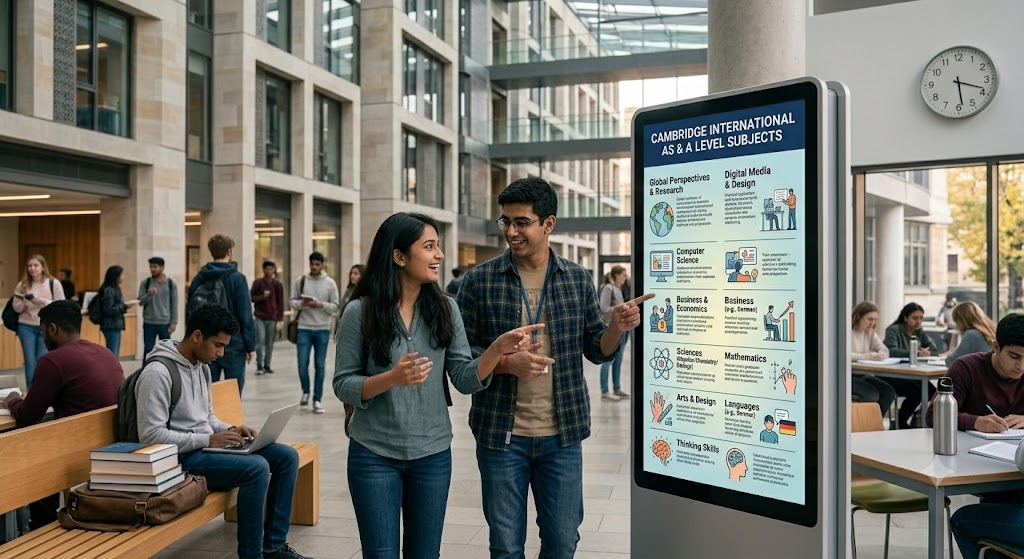
One of the biggest decisions students face before starting Cambridge International AS & A Levels is choosing the right subjects. The choice can influence university applications, academic workload and even the direction of future study.
Cambridge offers a broad range of 55 Cambridge International AS & A Level subjects, covering mathematics and sciences, languages, arts, humanities and interdisciplinary areas. This allows students to specialise in a particular academic direction or combine subjects from different fields.
What Subjects Are Available for Cambridge International AS & A Levels?
The Cambridge subject range is deliberately broad. It includes traditional academic subjects such as Mathematics, Physics, Chemistry, Biology, Economics and History, along with areas such as Computer Science, Psychology, Law, Media Studies, Digital Media & Design and Travel & Tourism.
The exact availability of a subject can depend on the examination series and the school offering the qualification. Students should therefore distinguish between subjects available within the wider Cambridge qualification and subjects actually offered by a particular school.
Mathematics and Science A Level Subjects
Students interested in engineering, medicine, computer science, natural sciences, mathematics and related fields have several options within the Cambridge subject range.
Common choices include Mathematics, Further Mathematics, Physics, Chemistry, Biology, Computer Science, Information Technology and Marine Science. Design & Technology, Environmental Management, Psychology and Sport & Physical Education are also included within the broader Cambridge Advanced subject offering, with some subjects having specific group or qualification arrangements.
Mathematics is particularly important for many quantitative university courses. Some degrees may also require specific combinations. For example, a university may ask for Mathematics and Physics for an engineering course, or Mathematics and Chemistry for a particular science pathway.
Further Mathematics is intended for students who want to pursue mathematics at a higher level and is especially relevant when a university course recommends or requires stronger mathematical preparation.
Cambridge International Language Subjects
The language selection is equally broad. Current Cambridge subject listings include languages such as Arabic, Chinese, French, German, Portuguese, Spanish, Tamil and Urdu, alongside English Language and several language and literature options.
Some language qualifications are available only at AS Level, while others have both AS and A Level routes. There are also separate Language & Literature qualifications in selected languages. This distinction matters when planning a subject combination. Students should check the exact syllabus code and qualification level rather than relying only on the general subject name.
Language subjects can be useful for students interested in literature, international relations, communication, linguistics, law, humanities and other fields. They can also provide academic breadth alongside science or mathematics subjects.
Arts and Humanities A Level Subjects
Cambridge offers a substantial range of arts and humanities subjects. These include Accounting, Art & Design, Business, Classical Studies, Economics, Geography, History, Law, Literature in English, Media Studies, Music, Psychology, Sociology and Travel & Tourism, among others.
These subjects suit different academic interests.
Economics and Accounting can support students interested in finance, business and economics. History, Literature in English and Classical Studies can provide useful preparation for humanities degrees. Geography combines physical and human perspectives and can lead towards several social science and environmental pathways.
Psychology is another popular option, particularly for students interested in human behaviour and social sciences. However, students should check individual university requirements because some psychology degrees have specific expectations around science or mathematics.
Interdisciplinary and Skills-Based Subjects
The Cambridge offering also includes subjects that sit outside the traditional science, language and humanities categories.
English General Paper, Global Perspectives & Research and Thinking Skills provide opportunities to develop broader academic skills. Global Perspectives & Research, for example, focuses on critical thinking, research and evaluating different perspectives. Cambridge describes the subject as a skills-based course involving critical analysis of evidence and comparison of perspectives.
These subjects can complement more specialised A Levels, although students should always check whether a particular university counts them towards its subject requirements.
How Many A Level Subjects Should a Student Choose?
There is no single subject combination that works for every student. The right number of subjects depends on the school, the student's academic goals and the requirements of the intended university courses. Some students choose a focused combination that allows them to specialise, while others select a broader group of subjects.
The important point is to avoid choosing subjects simply because they appear impressive. A strong subject combination is one that meets university requirements and allows the student to perform well.
How to Choose Cambridge A Level Subjects for University?
At Tutela Prep we always advise that University requirements should be checked before subjects are finalised.
A student interested in engineering, for instance, should examine the entry requirements of specific universities before deciding between Mathematics, Further Mathematics, Physics and Chemistry. A prospective economics student should check whether Mathematics is required or recommended by the universities being considered.
The same applies to medicine, computer science, architecture, psychology and other competitive courses.
Students should also consider whether they genuinely enjoy the subjects. A Level courses involve substantially deeper study than earlier secondary qualifications, so interest in the subject can make a meaningful difference over two years.
Can Cambridge Subjects Be Combined Freely?
Cambridge allows schools considerable flexibility in how subjects are combined. Its curriculum information states that schools can offer the 55 subjects in almost any combination, allowing learners either to specialise or study a broader range.
In practice, however, students are limited by the subjects their school offers and the timetable arrangements. Some combinations may also create scheduling conflicts.
The assessment route can vary by subject as well. Some subjects include practical, coursework, oral or project components, while others rely more heavily on written examinations. Students should therefore review the individual syllabus before committing to a subject.
Cambridge A Level Subjects in India
For Indian students, examination availability is another practical consideration. Cambridge runs a March examination series for selected syllabuses in India, alongside the wider June and November series. The March series has become an important option for students who need results in time for some Indian university admission timelines.
However, not every subject is available in every series. The current timetable and syllabus information should be checked before making academic plans around a particular examination session.
A Simple Way to Shortlist Subjects
A useful approach is to work through three questions.
1. What degree does the student currently want to pursue?
This identifies subjects that may be required or strongly recommended.
2. Which subjects play to the student's strengths?
A demanding subject combination should still be academically realistic.
3. What alternatives are available?
University plans can change during school, so retaining some flexibility can be helpful.
The final combination should meet university requirements without creating an unnecessary academic burden.
The range of Cambridge International AS & A Level subjects is one of the qualification's strongest features. Students can build a specialised science combination, pursue business and social sciences, focus on languages and humanities, or create a broader academic profile.
The best choice is rarely the combination with the most difficult subjects. It is the one that connects a student's interests, abilities and university plans in a sensible way. Checking university requirements early, understanding the individual syllabuses and choosing subjects carefully can make the next two years much more manageable.