info@tutelaprep.com
 +91 88263 45541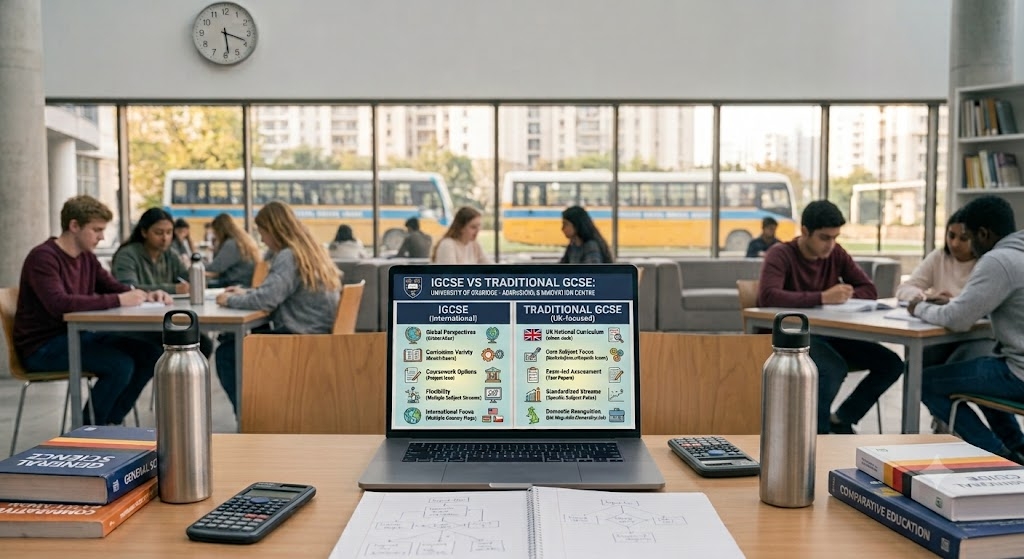
When it comes to widely respected and recognised school-level qualifications, we often come across the names of IGCSE and GCSE. However, a common question often asked by students is, “What is the difference between IGCSE and GCSE”? In this blog we will discuss what both courses are, and the key differences between these courses.
What is The GCSE Programme?
The General Certificate of Secondary Education, or GCSE, is a school-level qualification usually taken by students aged 14 to 16, typically at the end of Year 11 after a two-year course of study. GCSEs are mainly taken in England, Wales and Northern Ireland, though specifications and grading arrangements can differ across these systems. It is UK-centric for students who are studying in the British curriculum.
Numerous boards offer the GCSE course:
a) Assessment and Qualifications Alliance (AQA)
b) Pearson Edexcel
c) Oxford, Cambridge and RSA (OCR)
d) Council for Curriculum, Examinations and Assessment (CCEA)
e) Welsh Joint Education Committee (WJEC)
In England’s Key Stage 4 curriculum, the core compulsory subjects are English, mathematics and science. Schools also offer a wider range of optional subjects across humanities, languages, arts, design and technology, computing and other areas. These are:
- English Language and Literature
- Science
- Mathematics
In addition to core subjects, a broad range of optional subjects is also offered:
- Humanities
- Computing and Business
- Languages
- Arts and Design
Students generally opt for 8 to 10 subjects in total. Students commonly take around 8 to 10 GCSE subjects, though the number varies by school and student pathway. Many sixth-form and college routes ask for five GCSEs at specified grades, often including English and Mathematics.
What is The IGCSE Programme?
IGCSEs, or International GCSEs, are GCSE-style school qualifications designed for international learners and international schools. It is one of the most popular international qualifications globally, with millions of students undertaking these exams annually. This two-year programme is also for students in the age bracket of 14 to 16 years. The curriculum is primarily based on the British education system and is offered by various international boards such as Cambridge Assessment International Education, Pearson Edexcel, and Oxford AQA. Cambridge IGCSE is widely offered by international schools around the world and includes over 70 subjects, including around 30 languages.
Various international boards offer the IGCSE course:
a) Cambridge Assessment International Education (the original and most widely adopted)
b) Pearson Edexcel
c) OxfordAQA International Qualifications
Each of these boards follows the IGCSE framework, but they may differ slightly in subject lists and assessment style.
Many schools ask students to take between five and nine IGCSE subjects, though the exact number depends on the school’s curriculum model and the student’s pathway.
The group of subjects are:
- Languages
- Humanities and Social Science
- Sciences
- Mathematics
- Professional and Creative
#CTA#IGCSE Roadmap
Differences between GCSE and IGCSE
Though GCSE and IGCSE fall under the same kind of programme, they differ in many areas of their respective curriculum:
| Aspect | GCSE | IGCSE |
| Focus of the curriculum | GCSE specifications, especially in subjects such as English Literature, History, Geography or Citizenship, may reflect UK educational contexts more directly. IGCSE specifications are generally designed for international learners and avoid assuming deep familiarity with UK-specific contexts. | The IGCSE curriculum is designed to be culturally neutral and applicable to students in many different countries. It is done to avoid content that reflects UK-specific contexts or familiarity. |
| Assessment style | GCSE assessment traditionally employs a mix of written exams and coursework or controlled assessment. In recent reforms, the UK has shifted more towards examination-based assessments with fewer coursework components for many subjects. | The IGCSE assessment format varies by subject but is generally more flexible. It includes written examinations, practical assessments, or oral assessments. Some subjects offer alternative options for practical work with written exams. |
| Grading Scale | Students are graded on a scale of 9-1. Students must score a 4 to be awarded “standard pass” and 5 for “strong pass” | Cambridge IGCSEs are commonly graded A*–G internationally, though Cambridge also offers 9–1 grading in some administrative zones. Pearson Edexcel International GCSEs commonly use the 9–1 scale. |
| Availability | GCSEs are primarily taken by students attending schools in the UK, and the system is tied into England, Wales, and Northern Ireland’s national education framework. | The IGCSE is available worldwide and offered in international schools and many private or global curricula. It is not tied to a single national education system. |
| Content depth | Depth depends on subject and exam board. GCSEs in England follow regulated national subject content and assessment objectives. | Depth also depends on subject and board. IGCSEs are often designed for international cohorts and may place more emphasis on application to unfamiliar contexts. They are not automatically easier or harder than GCSEs. |
| Teaching pedagogy | GCSE teaching in UK schools is usually shaped by national curriculum expectations, school inspection systems and exam-board specifications. IGCSE teaching varies widely across international schools, but often uses international examples and may be adapted to different school calendars and learner backgrounds. | IGCSE teaching tends to emphasise conceptual understanding, practical application, and global perspectives, with many schools encouraging enquiry-based learning and skills development alongside subject knowledge. |
| Recognition and Purpose | GCSEs usually serve as the main qualification at the end of Key Stage 4 and help students progress to A Levels, vocational routes, apprenticeships or other post-16 pathways. | IGCSEs are designed to support progression to A Levels, International A Levels, IB Diploma Programme, Cambridge International AS & A Levels and other pre-university routes. |
| Examination Schedule | GCSE exams largely follow a fixed annual timetable set by UK exam boards, with limited additional session options. | Cambridge IGCSE exams are commonly held in May/June and October/November. In India, Cambridge also offers a March series for selected syllabi. Availability depends on the exam board, subject, country and centre. |
| Language and Assessment | GCSE papers may assume greater familiarity with UK educational and cultural contexts in some subjects. IGCSE papers are generally designed for international candidates and tend to use more globally accessible contexts. | IGCSE examinations use internationally neutral languages and contexts, making them more accessible to even non-UK students. The scenarios and examples in focus tend to be global rather than national. |