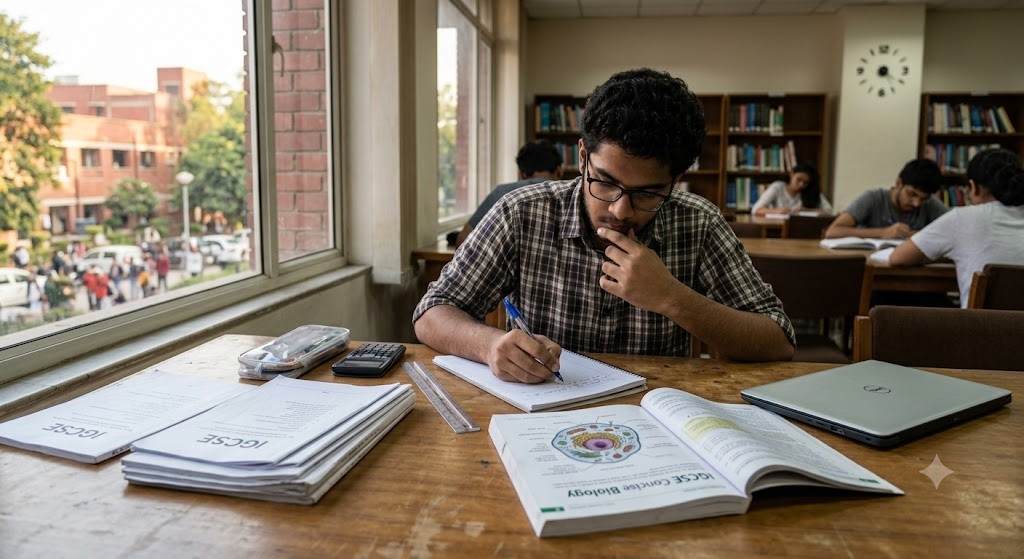
How to Effectively Prepare for the IGCSE Exams

Jul 16, 2026 | 01:46 pm

Prepare for IGCSE exams with smart planning, consistent revision, and effective exam strategies. This blog explores practical study techniques, subject-wise preparation tips, time management methods, and common mistakes to avoid, helping students approach their IGCSE examinations with greater confidence and clarity.

IGCSE Exams

The International General Certificate of Secondary Education (IGCSE) exams are just around the corner. Naturally, the anticipation and pressure inside the students would be running high. Running continuous sprints for hours through miles of notes, textbooks and PDFs, one might often find themselves in a mess.


So, Tutela Prep has you covered with effective methods to prepare for your IGCSE Certificate exams. Our guidance is grounded in the experiences of students and focuses on study techniques that maximise revision efficiency and exam performance.


 #CTA#IGCSE Roadmap

  1. Streamline your notes: It is advised to avoid copying textbook information blindly and focus on the topics that are likely to be asked in the exam. Making notes of those topics makes revision easier and more effective.
  2. Use Flashcards: Using flashcards is very helpful and effective as they help memorise definitions and technical terms of subjects like Sciences and Business Studies. Flashcards enable quick and active recalling and can also be used independently for daily revision sessions.
  3. Blurring Method: This method involves writing everything down on a blank sheet of paper with bullet points, numeric data, diagrams, etc. Then check with primary texts and notes to identify any gaps. This method can be actively used with verbal recitation of content to another person or to a mirror reflection.
  4. Solve previous years’ papers: Practising previous years’ papers is the most effective and practical way of preparing for any examination. Especially in the case of the IGCSE exams, they help to understand the theory more effectively and help solidify knowledge. Students also develop their time management skills by simulating real exam situations.
  5. Track progress with a Spreadsheet: Maintaining a spreadsheet during revision time helps students to document their progress with previous years’ papers, important topics, question codes, marks being scored in practice sessions, improvement areas, etc. 
  6. Maintain a Correction Notebook: A correction notebook should be a compilation of all difficult and frequently asked questions and concepts in a single place either in a physical notebook or a digital file. Reviewing this notebook will help students with quick revision, especially of challenging material.
  7. Build answer templates for every subject: Certain subjects in the IGCSE course, like Sciences, Geography, and Business Studies, show a repeated structure in the questions. It is advisable to keep some answer structures ready for frequently asked questions and topics that can be adapted in the exams.
  8. Dedicate ample time for sleep and maintain a proper diet: The effect of daily sleep hours of 8 to 9 hours every day with a healthy and nutritious diet helps maintain a sound body and mind for the challenging examination situations.



 

Frequently asked Questions

Q1. What is IGCSE and who is it designed for?

The International General Certificate of Secondary Education (IGCSE) is a globally recognised qualification for learners aged 14–16 years. Offered by boards such as Cambridge Assessment International Education, it builds strong foundations in knowledge, application, and critical thinking across subjects, preparing students for advanced study like A Levels, IB, or national senior secondary pathways.

Q2. How is the IGCSE syllabus structured across subjects?

The IGCSE syllabus is broken into clearly defined units with exact assessment weightings. For example, in Cambridge Assessment International Education:
Mathematics: Two written papers (Core or Extended) focused on algebra, geometry, mensuration, statistics, and probability.
English First Language: Reading paper (comprehension, summary) and Writing paper (directed writing, composition).
Biology: Theory paper, Multiple Choice paper, and either Practical or Alternative-to-Practical.
History: Structured source-based paper and an extended essay paper.

Q3. What does the IGCSE curriculum aim to develop beyond academics?

The IGCSE curriculum emphasises curiosity, problem-solving, data interpretation, communication, and independent learning. Apart from subject knowledge, students learn how to analyse case studies, handle source material, write structured responses, and apply concepts to real-world contexts. These skills are valued by universities worldwide.

Q4. How are the IGCSE exams assessed and graded?

The IGCSE exams include a mix of structured questions, extended responses, and subject-specific components such as practicals or coursework. Grades are usually awarded on a scale (e.g., A*to G or 9 to 1, depending on the board). Marking schemes are detailed and reward precise use of concepts, correct command-word responses, and clear working steps.

Q5. How should students prepare effectively for the IGCSE exam?

Preparation should begin with understanding the official IGCSE syllabus, followed by consistent practice with past papers and studying marking schemes. Learning main keywords, timing answers per question, and revising common mistakes are important. Since the IGCSE exam tests application as much as memory, practising structured answers is essential for scoring well.

Get in touch with us

For Expert Consultation, Diagnostic Test, or Demo Class for
SAT, AP, IB DP, IBMYP, IGCSE, ACT, PSAT, ESAT, TMUA,TARA and AMC.

Who are you?
Add your WhatsApp number for better communication